Best Baseball Players of All Time: A Definitive GOAT Analysis
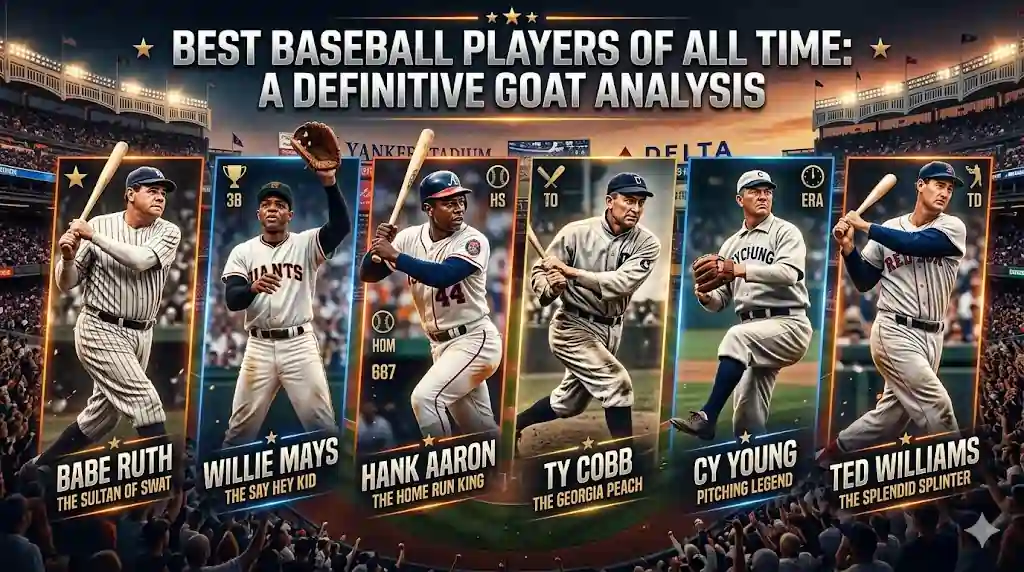
A tradition as old as baseball itself is the hunt for the greatest players of all time. It’s a debate waged in barbershops and broadcast booths, fueled by a century and a half of box scores, grainy film, and myth-making. But a simple, numbered listicle cannot capture the full picture. To truly define greatness, we must move beyond the tyranny of the ranked list and into the heart of a three-dimensional argument, examining the unbreachable peaks, the decades of sustained dominance, and the historical context that separates the legendary from the immortal.
This analysis isn’t about who is #1 versus #2. It’s about the criteria of induction into baseball’s Mount Rushmore. We’ll build a framework that honors the power-hitting revolution of Babe Ruth, the all-around genius of Willie Mays, the two-way impossibility of Shohei Ohtani, and the long-suppressed brilliance of the Negro Leagues, whose stars now officially sit atop the record books. This is the definitive analysis for how we should measure the men who defined baseball.
The Statistical Prison: Why Adjusted and Advanced Metrics Are Our Only Lens
Comparing players across baseball’s deeply stratified eras using raw numbers is an analytical dead end. The game of 1920, played in a dead-ball era’s wake with a new, lively cork-centered ball and no night games, is an alien planet to the high-velocity, launch-angle optimized, global talent pool of 2024.
A .300 batting average meant something fundamentally different for Rogers Hornsby in 1924 than it did for Tony Gwynn in 1994. The only honest method of comparison is through era-adjusted statistics. OPS+ and ERA+ normalize a player’s performance against the league average of their time, setting the baseline at 100. This single metric is more powerful than any raw home run total.
Consider this: a player with a 150 OPS+ was 50% better than a league-average hitter, whether he played in 1931 or 2024. For pitchers, an ERA+ of 150 means his park-adjusted ERA was 50% better than the league average. Wins Above Replacement (WAR) then attempts to roll this all-encompassing value—hitting, baserunning, fielding, and position—into a single number of wins contributed over a replacement-level player. It is an imperfect but indispensable tool. The true best baseball players of all time are clustered at the top of these career leaderboards, not just in raw counting stats.
The Ruthian Revolution: Babe Ruth and the Annihilation of Context
No single player redefined their sport so completely that they became a living adjective. “Ruthian” doesn’t just mean great; it means a performance so far outside the established bounds of the game that it seems to have arrived from a parallel dimension.
Before Babe Ruth, the single-season home run record was 27. In 1919, he hit 29. The revolution had begun. Then, in 1920, playing his first full season as a New York Yankee, Ruth hit 54 home runs—a number that eclipsed the total home runs hit by 14 of the other 15 major league teams that year. This is not just a record; it is a complete statistical annihilation of the sport’s fundamental offensive structure. His career OPS+ of 206 is a mountain that hasn’t been approached, representing a level of sustained, era-adjusted offensive dominance that is, in a word, untouchable. The direct answer is this: Babe Ruth didn’t just play baseball; he fundamentally changed what baseball meant.
| Player | Career OPS+ | Peak (Best 7 Seasons) OPS+ | Key Takeaway |
| Babe Ruth | 206 | 219 | The undisputed offensive outlier in the game’s history. |
| Ted Williams | 191 | 198 | The purest hitter, combining power and an unmatched eye at the plate. |
| Barry Bonds | 182 | 225 (2000-2006) | The most terrifying peak by raw numbers, but historically complex. |
| Willie Mays | 156 | 165 | The archetype of the five-tool player for two decades. |
| Mike Trout | 173 | 180 (2012-2019) | The modern benchmark for a complete, power-speed-walk superstar. |
Willie Mays, Context, and Integration in The War and the Wizard
A player’s career totals are a silhouette, but the missing years are the ghost that haunts the narrative. This is how we contextualize the Giants’ Willie Mays, perhaps the greatest all-around talent ever to step on a diamond.
Mays debuted in 1951 and won Rookie of the Year. He then missed nearly the entire 1952 season and all of 1953 for military service. He was 21 and 22 years old. When he returned in 1954, he immediately led the league in hitting and won the MVP, making “The Catch” in the World Series—a play so iconic it transcends sport. By the time his career ended, he had 660 home runs and 12 Gold Gloves as a center fielder. The analysis is clear: without the two lost prime years, Mays comfortably surpasses 700 home runs and adds even more to his WAR total, making the statistical race for the top hitter of the post-Ruth era a formality. No other player in history matches his synthesis of elite power, speed, defensive genius, and indomitable charisma.
The Peak of Peaks: Pedro Martinez and the Unhittable Prime
The inner circle of the best baseball players isn’t just about compiling 3,000 hits or 500 home runs. It’s also reserved for those whose best performance cluster was so unhittable, so untouchable, that it stands alone in the record books, even if their career totals don’t match those of the long-accruing legends. This is the case for Pedro Martinez.
From 1997 to 2003, at the absolute apex of the steroid era, when league-wide ERAs were bloated and sluggers were putting up video-game numbers, Pedro Martinez was doing something scientifically impossible. In 2000, he posted a 1.74 ERA in a league with a 4.91 ERA. His ERA+ that year was 291, the single greatest mark in baseball history for a starting pitcher. To put this in perspective, a 291 ERA+ means he was 191% better than the average pitcher. The average pitcher was giving up nearly five runs a game; Pedro was giving up less than two. This seven-year peak, including two years he was robbed of an MVP award, represents the most dominant mound performance over any offensive environment. His prime wasn’t just great; it was a logical paradox.
The Defensive Tiebreaker and Modern GOATs
Offensive stats drive the MVP votes, but defensive value is the analytical tiebreaker for true all-time greatness. Ozzie Smith’s 13 consecutive Gold Gloves don’t fully capture the chasm between him and the next-best shortstop. Brooks Robinson didn’t earn the nickname “The Human Vacuum Cleaner” at third base by making routine plays; he redefined the position’s geometry in a way that WAR’s defensive components are still trying to accurately measure.
This is the lens through which we must view modern candidates. Mike Trout’s first eight full seasons (2012-2019) are the closest thing to a Mays-ian peak we’ve seen, with a 180 OPS+, elite speed, and premium center field defense before injuries began to carve away his seasons. And then there is Shohei Ohtani. He is not just a great player; he is a category error. An All-Star-level elite designated hitter who also pitches at a top-of-the-rotation level. His 2021-2024 run has shattered the compartmentalized limits of a baseball player. Comparing him to Ruth is historically interesting, but Ohtani is doing this against the deepest global talent pool the sport has ever assembled. If he sustains this two-way production, we will need a new framework for GOAT entirely.
The Ghosts in the Record Books: Integrating the Negro Leagues
For decades, any discussion of baseball’s best players was tragically and artificially incomplete. In May 2024, Major League Baseball took a monumental step by officially incorporating the statistics of over 2,300 Negro Leagues players into its record books. This wasn’t a symbolic gesture; it was a statistical and historical correction.
The most seismic shift is at the top of the career leaderboards. Josh Gibson, known as the “Black Babe Ruth”—though some argued Ruth was the “White Josh Gibson”—is now officially MLB’s all-time career leader with a .372 batting average, surpassing Ty Cobb’s .367. He also holds the single-season records for batting average (.466 in 1943) and slugging percentage (.974 in 1937). Oscar Charleston was a five-tool superstar whose game was compared directly to both Mays and Ruth by those who saw them all. The historical silence on Cool Papa Bell’s speed or Satchel Paige’s ageless, unhittable brilliance is finally being broken by official data.
This integration reframes the entire debate. The best baseball players of all time list, as a historical document, now has new, statistically supported names at its summit, forcing a long-overdue re-examination of every player we once blindly called the “GOAT.”
The Criterion for Tomorrow’s Pantheon
So, how do we watch a game today and spot a future inductee into this pantheon? We don’t just look at the home run totals on the nightly highlight reel. We watch for the criteria this analysis has laid out:
- Sustained, Era-Adjusted Dominance: Is his OPS+ or ERA+ not just good, but historically elite for a 5-7 year period?
- The Unteachable Skill: Is he doing something that fundamentally warps the field of play, like Mays’ defense or Ohtani’s two-way mastery?
- The Counter-Narrative: Is he doing it in a way that defies the era’s conditions, like Pedro in the steroid era?
- Statistical Correction: Where does his performance, and the performance of historically excluded players, fit into the newly complete record book?
The final verdict on the best baseball players of all time is not a closed case. It is a living, breathing argument, one that gains richer dimension with every new analytical tool, every newly integrated historical record, and every generational talent who forces us to rethink what’s possible on a baseball diamond.
9. FAQ SECTION
Q: Who is considered the single best baseball player of all time?
A: There is no consensus single answer, but the debate typically centers on Babe Ruth for his unparalleled offensive dominance and Willie Mays for his complete five-tool mastery. Mays is often the pick for those who value all-around game and positional value, while Ruth’s statistical outlier status gives him the edge for many historians.
Q: Why isn’t [Modern Player] higher on all-time lists yet?
A: Longevity of greatness is the primary gatekeeper. A top-10 all-time player typically requires at least a decade of MVP-caliber play. A player like Mike Trout has a peak that rivals anyone in history, but the compounding value of a 20-year career free of major decline, like Hank Aaron’s, is needed to reach the very top of the WAR-based leaderboards.
Q: How do modern stats like WAR change the debate about older players?
A: WAR lets us see the hidden value of players like Brooks Robinson or Ozzie Smith, whose defensive brilliance was undervalued for decades. It equalizes offense, defense, and positional scarcity, providing a common cross-era currency that raw stats like RBI or batting average fail to offer.
Q: Is Shohei Ohtani already one of the all-time greats?
A: In terms of peak performance, yes. His two-way dominance is an unprecedented historical achievement. For an all-time career ranking, he is still building the longevity portion of his résumé. Another 5-7 years at this level will make his case undeniable and force a complete redefinition of what a baseball player can be.
Q: How did the Negro Leagues stats integration change the GOAT list?
A: It placed players like Josh Gibson and Oscar Charleston into the record books, where they belong. Gibson is now the official all-time leader in batting average and slugging percentage. This integration forces a reevaluation of players who played before 1947, whose statistics were compiled in a segregated, and therefore diluted, talent pool.
Q: What is a “five-tool player” and why is it important?
A: A five-tool player excels at hitting for average, hitting for power, baserunning speed, throwing arm strength, and fielding ability. It’s the rarest and most complete profile in baseball. The term is synonymous with Willie Mays, who set the standard, and modern players are measured against his template to be considered truly all-around greats.
10. SECONDARY KEYWORDS USED
- greatest MLB players
- baseball GOAT analysis
- MLB all-time greats
- era-adjusted baseball statistics
- OPS+ career leaders
- Willie Mays vs Babe Ruth
- Josh Gibson Negro Leagues records
- Pedro Martinez peak 1999-2000
- Shohei Ohtani two-way player comparison
11. SUGGESTED REFRESH TRIGGER
This is an evergreen article. A content refresh should be triggered in 3-5 years or when:
- A current superstar (e.g., Shohei Ohtani, Juan Soto, Ronald Acuña Jr.) completes a 5-year peak that statistically challenges historical benchmarks.
- A major career record (e.g., a new member of the 700 HR club) is broken, or an active player retires with a top-5 all-time career WAR ranking.
- MLB announces a further major data integration project that significantly alters the official historical record.